
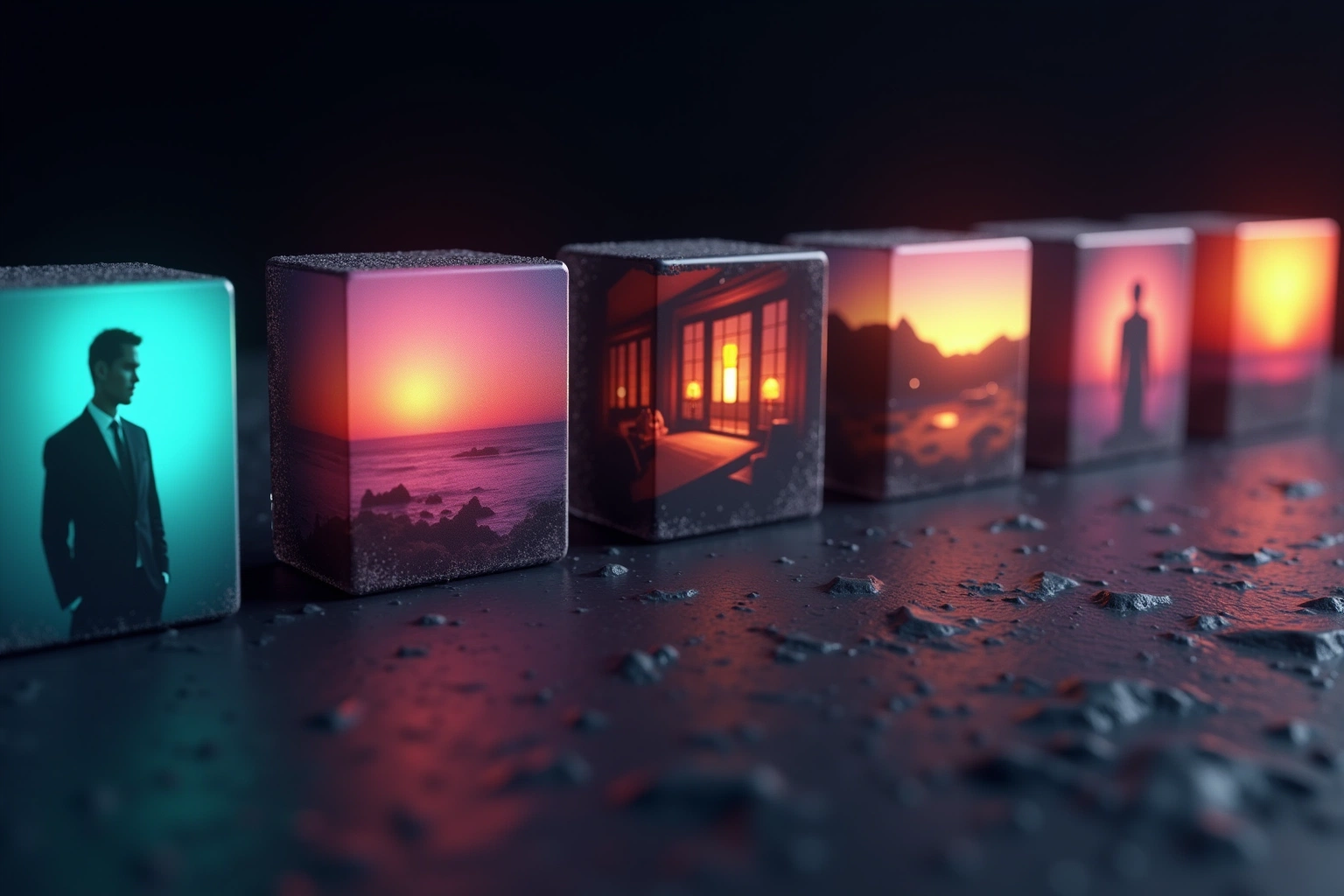
Write an AI image prompt as a short visual brief: subject, action, setting, composition, lighting, and style. Put the main subject first. Use concrete visual words. Generate a small set, find the largest problem, and change only that part.
A good prompt does not need to sound clever. It needs to be easy for the model to parse and easy for you to revise.
Adobe’s current Firefly prompt guidance recommends simple, direct, descriptive language. That advice works across many tools. The exact response still depends on the model.
The six-part image prompt formula
You do not need all six parts for every image. Use the pieces that change what a viewer would see.
1. Subject
Name the main person, object, creature, or place.
An adult woman in a tailored red suitA brushed steel espresso machineA ruined observatory on an ice moon
2. Action or state
Say what the subject is doing or how it is arranged.
walking through falling raincentered on a stone counterhalf buried beneath blue ice
3. Setting
Give the scene a place, time, and useful background.
downtown at midnightquiet modern kitchen at sunrisewide alien valley under two moons
4. Composition
Tell the model how the scene should fit the frame.
waist-up portrait, eye-level camerathree-quarter product view, centeredwide establishing shot, subject on the right
5. Lighting and color
Light defines shape and mood.
soft north-window light, warm neutral palettehard blue rim light, deep black shadowsgolden-hour backlight, faded earth tones
6. Style or medium
Name the type of image, not only a vague quality word.
realistic editorial photographhand-painted fantasy concept artclean 3D product render
Adult woman in a tailored red suit, walking through falling rain, downtown at midnight, waist-up portrait at eye level, hard blue rim light and warm storefront glow, realistic editorial photograph with natural skin texture.
This order is a starting pattern, not a law. If the composition is the main challenge, put it earlier.
Prompt examples you can adapt
Realistic portrait
Adult man, age 35, standing beside a workshop window, relaxed expression, chest-up portrait, eye-level 85mm lens, soft side light, muted brown and slate palette, realistic editorial photograph, natural skin texture
Product photo
Matte black wristwatch on folded charcoal linen, small studio table, three-quarter view, centered with clean negative space, soft overhead strip light, premium catalog photography, crisp metal and fabric texture
Interior
Compact listening room with walnut shelves and two cream chairs, evening, wide corner view, warm table lamps and faint blue window light, calm mid-century interior photograph
Fantasy scene
Lone cartographer crossing a bridge above a glowing forest, wind moving a long coat, wide establishing shot, moon behind clouds, teal and amber palette, detailed fantasy concept art
Stylized character
Confident adult space pilot, age 29, orange flight jacket and dark utility pants, leaning against a small spacecraft, three-quarter character view, graphic rim light, polished semi-realistic 3D character art
Website hero with copy space
Sculptural glass perfume bottle on black stone, low camera angle, subject grouped on the right third, wide dark negative space on the left, lime edge light and soft silver fill, premium campaign photography, 16:9 composition
The last example includes layout needs because the image has a job beyond looking good.
Control composition with camera language
Composition words often have a stronger visible effect than extra style words.
| Goal | Useful prompt language | What it changes |
|---|---|---|
| Show a face | Close-up, headshot, 85mm portrait | Fills the frame with the subject |
| Show clothing | Full-body, head-to-toe, standing pose | Keeps more of the figure visible |
| Show the world | Wide establishing shot, 24mm lens | Adds setting and depth |
| Make it intimate | Eye-level, shallow depth of field | Feels close and focused |
| Make it powerful | Low camera angle, strong vertical lines | Makes the subject feel larger |
| Leave room for text | Subject on right third, negative space left | Creates a usable layout |
| Reduce clutter | Single subject, simple background | Gives the model fewer conflicts |
Canvas shape and composition work together. A portrait prompt inside a wide canvas may add extra people or background objects to fill space. Pick the aspect ratio and resolution before you fine-tune the layout.
Describe lighting and color
“Cinematic” is common because it can suggest polished contrast and drama. It is also broad. Add the visible cause.
Light direction
front lightgives even detailside lightshows texture and shapebacklightcreates a bright edge and silhouettetop lightcan feel severe or theatricalunderlightfeels unusual or eerie
Light quality
soft diffused lightcreates gentle transitionshard direct lightcreates sharp shadowsovercast daylightis cool and evenwarm practical lampsappear to come from lights in the scenecolored gel lightingadds bold color contrast
Color control
Name two or three key colors instead of asking for “colorful.” Use material colors when possible: oxblood leather, smoked glass, aged brass, cream paper.
Weak: dramatic cinematic lighting
Better: soft amber lamp light from the left, narrow blue rim light from behind, deep neutral shadows
Do negative prompts help?
A negative prompt tells a compatible model what to avoid. Some tools provide a separate field. Others only accept one positive prompt or ignore negative language.
Use negatives for a short list of repeated failures:
extra fingers, duplicate objects, unreadable labels, watermark
Do not write a wall of hundreds of banned words. Large negative lists can pull attention away from the main request or cause unexpected tradeoffs.
Try positive direction first:
- Instead of
no clutter, usesingle object on a clean empty table. - Instead of
not blurry, usesharp focus on the eyes. - Instead of
no extra people, useone person alone in the frame.
The model page should tell you whether negative prompts are supported. WaveSpeedAI’s FLUX Dev API page, for example, lists the exact request fields for that model.
Fix a weak result without starting over
Use the “one-change loop.”
If the image feels generic
Replace praise words with visual facts. Add a specific material, time of day, camera position, or color relationship.
If the subject is missing an item
Move that item closer to the start. Remove less important details. Make its relationship clear: holding a folded red umbrella in her left hand.
If the scene is crowded
Ask for one subject and a simple background. Use a tighter camera view or a canvas closer to the final crop.
If the face or hands are weak
Generate another seed first. Then simplify the pose, use a closer crop, or repair the area with inpainting. Text alone cannot fix every model limit.
If the style drifts
Use a style reference when the tool supports it. Adobe explains that style references guide the visual look, while composition controls guide structure.
If nothing works
Try a model made for the task. Prompting skill cannot turn a weak text model into a typography model or a loose portrait model into an identity-preserving editor.
Write narrower prompts for edits
An edit prompt should define three things:
- What changes
- What replaces it
- What must stay the same
Weak: Make this better
Better: Replace the gray sky with soft sunset clouds. Keep the building, camera angle, reflections, and crop unchanged.
For a clothing edit:
Change only the jacket to dark green suede with brass buttons. Keep the person’s face, hair, pose, hands, background, and lighting unchanged.
Adobe’s current image-editing guide also recommends direct everyday language for the change. Preserve instructions may need to be repeated because models can drift beyond the selected area.
Adult prompts need clear age and consent
For lawful fictional adult art, make adulthood visible in both the prompt and the result.
Use:
adult woman, age 28mature adult facial structureadult nightlife fashion editorialall subjects are clearly over 25
Avoid school settings, youth-coded clothing, childlike proportions, or words that create age uncertainty. If the output looks young, reject it even when the prompt included an adult age.
Do not use a real person’s name or face for an intimate image without specific permission. Read Responsible Adult AI Generation and Real-Person AI Images and Consent before working with likenesses.
A fictional label does not make a youthful-looking sexual image safe. Judge the visible output, not only the words you typed.
Copyable prompt worksheet
Use this as a draft, then remove any line that does not help.
Subject: [who or what]
Action: [what is happening]
Setting: [where and when]
Composition: [crop, angle, placement, lens]
Lighting: [direction, softness, source]
Color: [two or three key colors]
Style: [photo, illustration, 3D, medium]
Must keep: [for edits]
Avoid: [short list, only if supported]
Then use this review:
- Can I picture the subject after the first line?
- Does every phrase describe something visible?
- Do any instructions fight each other?
- Does the canvas shape fit the composition?
- Is one detail more important than the rest? If so, move it earlier.
- For an edit, did I say what must remain unchanged?
- For adult work, are age and consent clear?
The best prompt is not the longest prompt. It is the shortest prompt that gives the model the right job and gives you a clear next edit.